Yes, you can build real strength at home with a smart plan, consistent effort, and equipment that matches your space and budget. Strength training at home can include bodyweight exercises, resistance bands, dumbbells, kettlebells, or a simple home gym setup. This guide explains how to start safely, what to focus on, and how to make home workouts challenging enough to keep improving.
Can I do strength training at home?
Yes, you can do strength training at home, and for many people it is one of the most practical ways to stay consistent. You do not need a full rack of machines to train your muscles effectively; you need exercises that challenge your body, a clear routine, and a way to progress over time.
At-home training works because muscles respond to tension, effort, and repetition. That tension can come from your body weight, a resistance band, a pair of adjustable dumbbells, a backpack loaded with books, or a compact home gym. The key is choosing movements that train major muscle groups and performing them with control.
A strong home routine usually includes lower-body work, upper-body pushing, upper-body pulling, core training, and hip-hinge movements. When those patterns are covered, your workouts become balanced rather than random.
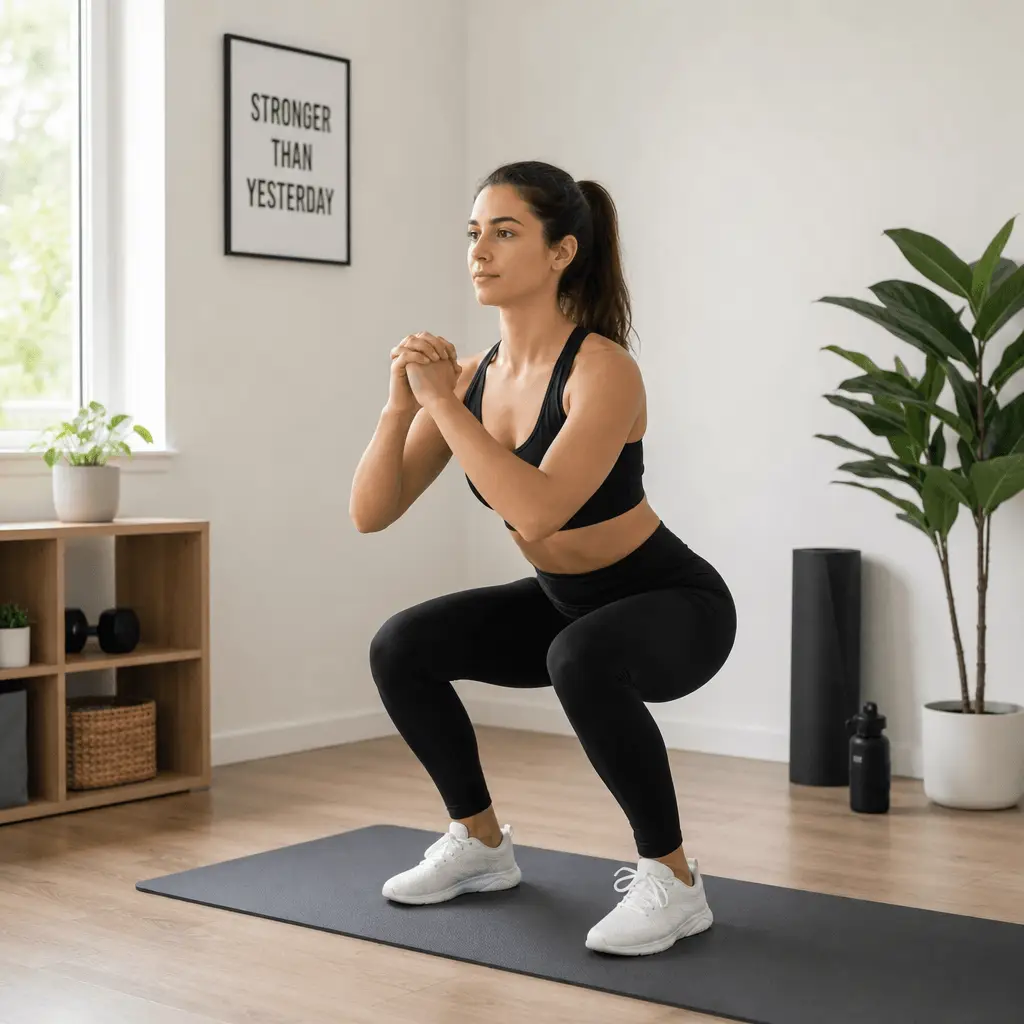
What strength training at home can look like
Strength training at home does not have to look like a commercial gym session. It can be quiet, simple, and flexible. You might train in your living room before work, use a spare bedroom as a workout corner, or keep a few pieces of equipment in a closet.
A beginner session might take 25 to 35 minutes and include squats, push-ups, glute bridges, rows, and planks. A more advanced session might use heavier dumbbells, slower tempos, single-leg movements, or supersets to increase difficulty. Both approaches can be effective when they are structured well.
Here is a simple way to think about your weekly plan:
Two days per week: A good starting point for beginners or anyone returning after a break.
Three days per week: A balanced schedule for steady progress and recovery.
Four days per week: Helpful if you want to split upper and lower body sessions.
Short daily sessions: Useful when your schedule is busy, as long as you avoid training the same muscles hard every day.
Consistency matters more than having the perfect setup. A modest routine you actually follow will do more for you than an ambitious plan that feels impossible after one week.
Your body weight is enough to begin
Bodyweight exercises are often underestimated because they look simple. In reality, they can be highly effective when you adjust leverage, tempo, range of motion, and volume. Squats, lunges, push-ups, wall sits, step-ups, planks, and glute bridges can build coordination and foundational strength.
For beginners, bodyweight training also teaches control. You learn how your knees track during squats, how your core supports your spine, and how your shoulders feel during pressing movements. This awareness helps reduce sloppy reps when you later add weights.
Try this beginner-friendly circuit:
Chair squats — 8 to 12 reps
Incline push-ups against a counter or sturdy table — 6 to 10 reps
Glute bridges — 10 to 15 reps
Bird dogs — 6 to 10 reps per side
Forearm plank — 15 to 30 seconds
Repeat the circuit two or three times, resting as needed. Move slowly enough that each repetition feels intentional, not rushed.
How do I make home workouts harder over time?
You make home workouts harder by using progressive overload, which means gradually increasing the challenge your muscles must handle. At home, that can mean adding reps, increasing resistance, slowing the movement down, reducing rest time, improving range of motion, or moving to a harder exercise variation.
For example, a wall push-up can become an incline push-up, then a floor push-up, then a slow-tempo push-up. A basic squat can become a pause squat, split squat, goblet squat, or single-leg variation. You do not need to change everything at once; small increases are usually easier to recover from and easier to track.
Use one or two of these progression methods at a time:
Add repetitions until you reach the top of your target range.
Add sets when the workout feels too easy but your form is still strong.
Slow the lowering phase to create more time under tension.
Pause at the hardest point of the movement for one to three seconds.
Add resistance with bands, dumbbells, a kettlebell, or a weighted backpack.
Choose a more difficult variation once the current one feels controlled.
A simple training log can help. Write down the exercise, sets, reps, resistance, and how hard the final set felt. If the same workout feels easier after a few sessions, you have evidence that your strength is improving.
Low impact strength training at home
Low impact strength training at home is a smart option if you want to build muscle and joint stability without jumping, running, or high-impact movements. It can be especially useful for beginners, people in small apartments, or anyone who prefers quieter workouts.
Low impact does not mean low effort. A slow split squat, controlled dead bug, resistance-band row, or wall sit can be very challenging. The goal is to reduce pounding on the joints while still asking the muscles to work.
Consider these low impact movements:
Sit-to-stand squats from a chair for legs and hips.
Step-ups on a stable low step for single-leg strength.
Glute bridges for hips, glutes, and hamstrings.
Wall push-ups or incline push-ups for chest, shoulders, and arms.
Resistance-band rows for upper back strength.
Dead bugs for core control and coordination.
Keep your movements smooth, breathe steadily, and stop if you feel sharp pain. Muscle effort is expected; joint pain is a signal to adjust the exercise, range of motion, or resistance.
Building a simple home gym
A home gym can be as minimal or as complete as you want. You can start with a mat and your body weight, then add equipment as your needs become clearer. Buying everything at once is rarely necessary.
For most people, a practical setup includes:
Exercise mat: Helpful for floor work, stretching, and core training.
Resistance bands: Affordable, compact, and useful for rows, presses, and mobility drills.
Adjustable dumbbells or a few fixed pairs: Useful for squats, hinges, presses, and carries.
A sturdy chair or bench: Helpful for step-ups, incline push-ups, and seated exercises.
Door anchor or suspension trainer: Optional, but useful for pulling exercises if installed safely.
Before adding equipment, ask what problem it solves. If you struggle to train your back, bands or a suspension trainer may be helpful. If squats feel too easy, dumbbells may be the next logical step. Your home gym should support your plan, not become clutter.
A sample weekly strength plan
A balanced plan helps you avoid doing only the exercises you enjoy. It also gives your muscles time to recover, which is when adaptation happens. The following schedule works well for many beginners and can be adjusted to your fitness level.
Day 1: Full body strength
Squat variation: 3 sets of 8 to 12
Push-up variation: 3 sets of 6 to 12
Band row or dumbbell row: 3 sets of 8 to 12
Glute bridge: 3 sets of 10 to 15
Plank: 2 sets of 20 to 40 seconds
Day 2: Rest or gentle movement
Take a walk, stretch, or do light mobility work. Recovery days help you return stronger for the next session.
Day 3: Full body strength
Reverse lunge or step-up: 3 sets of 8 to 10 per side
Dumbbell floor press or incline push-up: 3 sets of 8 to 12
Hip hinge with dumbbells or backpack: 3 sets of 8 to 12
Shoulder press with bands or dumbbells: 2 to 3 sets of 8 to 12
Dead bug: 2 to 3 sets of 6 to 10 per side
Day 4 or 5: Optional third workout
Repeat Day 1 or choose lighter low impact strength training at home. If you are sore, reduce volume and focus on technique.
Common mistakes to avoid
Home workouts are convenient, but convenience can make it easy to rush, skip warm-ups, or train without a plan. A little structure prevents most problems.
Avoid these common mistakes:
Doing random exercises every session: Variety is fine, but progress is easier when you repeat key movements.
Ignoring pulling exercises: Push-ups are popular, but rows and band pulls help balance the shoulders and upper back.
Training too hard too soon: Soreness is not the goal. Build gradually so the habit lasts.
Using poor form to get more reps: Stop a set when your technique breaks down.
Skipping recovery: Muscles need rest, nutrition, and sleep to adapt.
Think of each workout as practice. Better reps today create better results later.
Why choose us
If you are choosing this guide as your starting point, the benefit is a practical, realistic approach to strength training at home. Instead of suggesting that you need a perfect home gym or an intimidating routine, this method focuses on movements you can scale to your body, your schedule, and your available space.
The approach is simple: start where you are, train the major movement patterns, progress gradually, and stay consistent. That makes it useful whether you are new to strength training, rebuilding after time away, or trying to make home workouts feel more organized.
FAQ
Do I need equipment to start strength training at home?
No. You can start with bodyweight exercises such as squats, push-ups, lunges, planks, and glute bridges. Equipment becomes useful when you need more resistance or want more exercise options.
How long should a home strength workout be?
Most effective home sessions can be completed in 25 to 45 minutes. A shorter workout can still be valuable if it includes focused sets, good form, and enough effort.
Can beginners do strength training at home safely?
Yes, beginners can train safely at home by starting with simple movements, using controlled speed, and choosing exercises that match their current ability. If you have medical concerns or pain, check with a qualified professional before beginning.
How often should I train?
Two to three strength sessions per week is a strong starting point for many people. As your fitness improves, you can add sessions or increase difficulty while keeping recovery in mind.
Build Real Strength Without Ever Stepping Foot in a Gym
You don’t need an expensive gym membership or a room full of bulky equipment to build muscle, boost your energy, and transform your health. Effective strength training can easily happen right in your living room using simple bodyweight movements, resistance bands, or dumbbells—all on your own schedule. If you’re ready to build a stronger body safely and conveniently from the comfort of home, we’re here to guide you step-by-step. Contact us today to receive your personalized home-workout consultation and get a training program built specifically for your space, equipment, and fitness level.